Trending
This story is from February 7, 2016
Sláinte
You aren’t in love with your amber unless you do a round-up of Scottish distillaries. Then, there are those long walks into brooding wilderness.
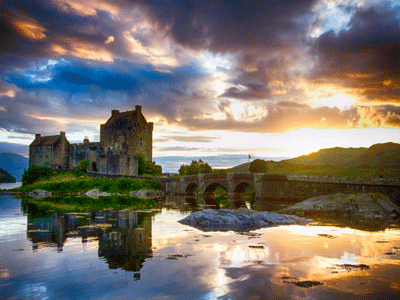

Whisky is probably the best known of Scotland’s manufactured products. From the outlaw distillers in the 18th century, it has become a global enterprise today, valued at £4.3 billion in 2013, which was 85 per cent of Scotland’s food and drink exports. It supports around 10,000 jobs directly, and 25,000, indirectly. But it isn’t just any whisky – derived from the Gaelic word uisgebeatha, meaning ‘water of life’ – that thirsty travellers come looking for. The off-the-charts demand for single malts whisky has brought about unprecedented interest and traffic to distilleries in Scotland, which have woken up to the advantages of welcoming whisky-loving tourists. With visitors buying whisky-related merchandise, eating in local restaurants and staying at local inns, the distilleries are not dependant on just selling whisky to generate profits. Scotland has nearly 100 active malt distilleries — 98 to be exact — so it really isn’t tough to find one.
The island of Islay alone has 11 distilleries. I chose to visit one in Tain, the little Royal Burgh that is Scotland’s oldest, going by the 1066 royal charter. With a population of less than 4,000 folks, Tain is perfect for a city-weary traveller looking for tranquillity and a digital detox. Hidden in its country lanes and narrow roads are treasures that unravel on long walks and over a pint in the local pub. With the sea on one side and rolling green fields on the other, Tain, with its friendly folk and friendlier dogs, is the kind of place you will want to call home. And also the fact that it makes one of the most popular single malt whiskies in the world. (Hint: it rhymes with orangie). Loved by millions around the world, the distillery — overlooking the dramatic Dornoch Firth — is the area’s biggest tourist attraction. The distillery runs 24 hours a day, seven days a week, with a little break around Christmas; but with the company targeting a staggering six million litres of Scotch a year, it’s always busy and whirring with sounds and smells. Large groups descend on the visitors’ centre for a peek into how barley and mineral spring water — the whisky’s water source is Tarlogie Springs — get turned into an extremely flavourful, silky-smooth amber liquid, all for the lowly price of 5 quid. You could also get a heritage tour for £120, which includes a trip to Tarlogie Springs and a gourmet lunch. And the fact that you can sample a dram of any range of single malts at the distillery shop, for extra, just makes the deal intoxicatingly sweeter. The summer season can get busy so pre-booking the tour is always a good idea.
The distillery today stands where the Morangie Farm once stood. It is said that the production of alcohol started at Morangie Farm in 1738, when a brewery was built that shared Tarlogie Springs, the farm’s water source. But in 1843, a former distillery manager, William Matheson, acquired the farm and converted the brewery into a distillery, equipped with two second-hand stills. Today, 180 years later, the number of shiny copper stills has gone up to 12, six wash and six spirits. Standing at 5.14 metres, they are the tallest in Scotland and also one of the reasons for the whisky’s unique finish. The tall stills ensure that only the purest, most delicate vapours are condensed into spirit. Sixteen men of Tain brought out the first ever batch of whisky. Expansion has meant that there are now 24 mashmen, stillmen and warehousemen who work round the clock, and are referred to on bottles, and in promotional leaflets as The Men of Tain. For whisky aficionados, the tour is obviously right on top of the to-do list, but even for those with little patience or taste for whisky, the tour offers fascinating insights into the traditional process of whisky making.
Like how 48,500 litres of wort — a sugary liquid produced from washing barley grist with hot water — and yeast take 52 hours to ferment in the steel washbacks. If you have a blocked nose, just a single whiff from one of those washbacks will set you right. Or that the whisky is matured in casks that were previously used to mature bourbon or wine, port or sherry. The guides are friendly, knowledgeable and passionate about whisky and more importantly, encouraging of those who want to savour and taste as many whiskies as possible. After five tastings or drams of whisky, life was indeed beautiful that glorious July afternoon. Savour your whisky – we tell you how If you can’t
travel to Scotland, fret not.
Here are some tips on how to organise your very own whisky tasting.
- The type of glass that you use will help your cause massively. It is best to use one that has a narrow opening as this will channel and concentrate the aromas of the whisky towards your nostrils. This type of glass is called a snifter but small brandy snifters or white wine glasses will work just fine. Make sure your glassware is clean and free of detergent.
- Six to eight whiskies are plenty – especially if you are swallowing. If you taste too many whiskies, your palate will eventually become fatigued.
- Pour a reasonable amount of whisky into the glass and swirl it around for a short time to allow the oxygen to get into the liquid and the evaporation to begin. Let it breathe.
- Remember not to drink the whisky too fast (like a shot of cheap Tequila). Rather, savour it in your mouth to get the maximum flavour and benefit. When you swallow, there will be an alcoholic burn. Don’t give up. If you persevere, the whisky will reveal its true characteristics. Have fun trying to identify flavours that are present, and the ones you can taste. Should I add water or ice? A common question and one that only you can answer. Always try a whisky in its natural state first and then add water as this can release further flavours and complexity. It is far more pleasant with water in some cases and how much water you add is up to you. Make sure the water you have for your whisky is non-carbonated, room temperature, and clean (e.g., spring water)
Things to keep in mind
Guided tours start every half hour during summer from 10.30 am and the last tour starts at 3.30 pm. In winter, tours start at 10 am; groups are welcome.
How to reach Tain: There are up to eight trains to Tain from Inverness, daily. You could take the hourly bus or just choose to drive down for the 40-minute road journey
End of Article
FOLLOW US ON SOCIAL MEDIA








Featured In Lifestyle

Popular Categories
Entertainment NewsBollywood NewsTollywood NewsKollywood NewsMollywood NewsMovie ReviewsLatest Hindi MoviesLatest Tamil MoviesMX PlayerParenting TipsHome RemediesWeight LossBeauty TipsParenting TipsHindi VideosHindi Video SongsBhojpuri Music VideosLatest Telugu MoviesBhojpuri Music VideoHindi TV News
Trending in Entertainment
Latest MoviesBollywood MoviesHollywood MoviesTamil Movies 2024Telugu Movies 2024Malayalam Movies 2024Kannada Movies 2024Marathi Movies 2024Bengali Movies 2024Top Rated Movies 2024Best Hindi MoviesBest English MoviesBest Telugu MoviesBest Tamil MoviesBest Malayalam MoviesBest Kannada MoviesBest Bengali MoviesUpcoming Hindi MoviesBest Movies Of All TimeBest Hindi Movies of All Time
Trending in Etimes
Horoscope TodayNumerology Predictions TodayKamala HarrisBrisk WalkingPrince HarryElon MuskDonald Trump DonationsSayuri DeathHaitian President SpeechElon Musk MotherJD Vance Vs Tim WalzEric AdamsKamala HarrisPeanut Butter Vs Almond ButterMagnesium DeficiencyRelationship TipsSean Diddy CombsAlzheimers DiseaseFunniest Wildlife Photos 2024
Trending in TV
Trending in Lifestyle
Trending in Regional
Movie Reviews
Binny And Family ReviewLove, Sitara ReviewWill & Harper ReviewWolfs ReviewYudhra ReviewJo Tera Hai Woh Mera Hai ReviewKahan Shuru Kahan Khatam ReviewHis Three Daughters ReviewNever Let Go ReviewDancing Village: The Curse Begins ReviewTransformers One ReviewFirst Love ReviewBerlin ReviewThe Buckingham Murders Review
Upcoming Hindi Movies
Upcoming Regional Movies
Latest News
The Power of Color: Zodiac Signs and Their Energetic HuesRs 40.87 crore cash, goods seized since inception of mode code: DGP Kapoor'That was the last time I saw my friend': Rahul Gandhi remembers Sitaram YechuryTulsi Gabbard calls Kamala Harris shameless as VP inspects US-Mexico border: 'No conscience'Cockroach found in Air India passenger's meal on Delhi-New York flight; know what airline respondedGuneet Monga says, 'films with American distributors should be sent for competition'SC handbook lists terms to be avoided to refer to persons with disabilities, provides alternativesScrap dealer dad celebrates son's board exam success by gifting multiple iPhones | Watch videoForeign investment hits record high with Rs 23,600 crore inflows this weekWatch: Pakistan Test team head coach Jason Gillespie to make changes only after...Ex-WWE Writer Vince Russo Voices Frustration Over Triple H's Handling of LA KnightQueen Camilla does not want King Charles to meet Prince Harry because...Mapusa rain surges past 4,000mm markCongress leader Pawan Khera asserts people of Haryana want change ahead of assembly electionsRG Kar case: West Bengal junior doctors to resume 'cease work' following SC hearing on MondayIt’s ‘karma’ that Pakistan ills are consuming its own society: Jaishankar in UNGAZodiac Signs as Barbie Dolls: Finding Your Cosmic DollWeekly Horoscope, September 29 to October 5, 2024: Read weekly astrological predictions
Other Group Sites -
ETimes is an Entertainment, TV & Lifestyle industrys promotional website and carries advertorials and native advertising.